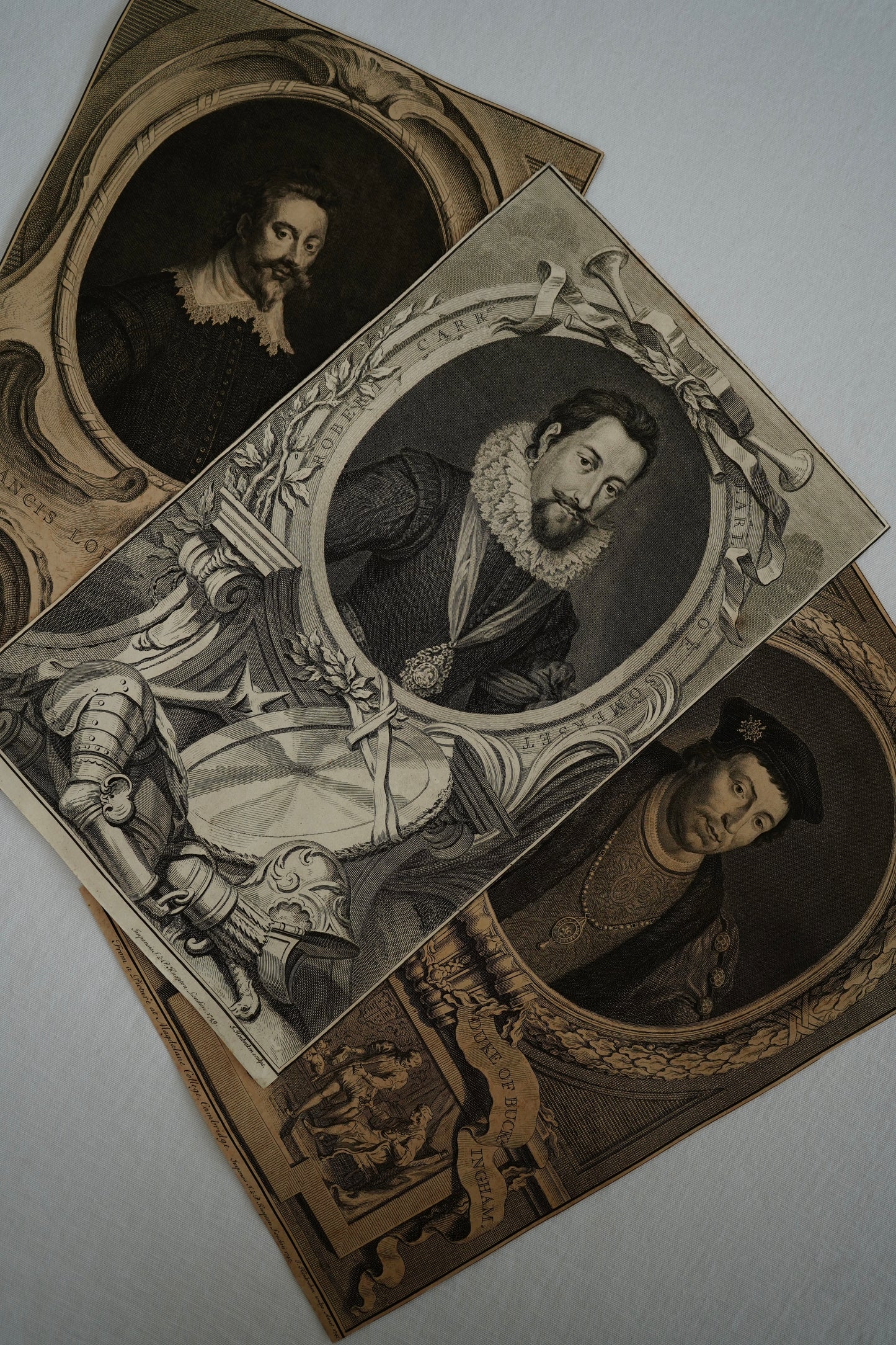
Early 19th Century Engraving "Duke of Buckingham" by Jacobus Houbraken
Early 19th Century Engraving "Duke of Buckingham" by Jacobus Houbraken
Couldn't load pickup availability
Henry Stafford, Duke of Buckingham, is one of the most compelling and ultimately tragic figures of the Wars of the Roses. He was Richard III's most powerful ally in the seizure of the throne, the man who helped orchestrate the deposition of Edward V, and then, within months, the leader of a rebellion against the very king he had helped create. He was beheaded in Salisbury marketplace in 1483, aged somewhere around twenty-six. History has never quite settled on what he was: opportunist, idealist, or simply someone who miscalculated at the worst possible moment.
Houbraken gives him a face that holds all of that ambiguity. The portrait, engraved after a picture then in the possession of Magdalene College, Cambridge, shows a heavy-set man in the dress of the Yorkist court, a jeweled medallion at his chest, a fur-trimmed robe, the flat black cap of the period set at an angle that suggests authority without arrogance. The oval wreath cartouche that frames him is one of Houbraken's most elegant compositional devices, and the narrative vignette below the portrait, a multi-figure scene rendered with the same precise, controlled line as the portrait itself, adds the storytelling dimension that distinguishes these prints from simple likenesses.
Artist Biography
Jacobus Houbraken (1698-1780) was a Dutch engraver, apprenticed under his father, Arnold Houbraken (1660-1719). Houbraken’s style was similar to the portrait engravers of the great seventeenth century French school, most notably, Nanteuil, Drevet and Edelinck. He surpassed these masters in his ability to capture textures and tones. The Italian engraver, Raphael Morghen said, “No engraver has ever equalled, and probably will not equal, the Dutchman Jacobus Houbraken, in the manner of imitating the flesh and the hair by means of the graver.” He was sought after by both English and Dutch publishers. His most famous engravings for English publication were those for the historical series, "The Heads of Illustrious Persons of Great Britain", published in parts in London between 1734 and 1752. He worked alongside George Vertue (1684-1756), but most of the great portrayals were left to Houbraken, including those of Newton, Pope, Dryden, Shakespeare and Milton. Under the framed portrait of each individual, he designed and engraved the vignettes and objects associated with each person. Jacobus Houbraken's most important set of original portrait engravings, The Heads of Illustrious Persons of Great Britain, required almost twenty years to complete. The set contains one hundred and eight portraits of British luminaries dating from the 14th to early 18th centuries including Kings, Queens, noblemen, politicians, writers, scientists and philosophers.
Good condition for a work of this age. Even surface discoloration throughout the sheet, consistent with age. The sheet has been trimmed within the plate mark. Please refer to the photographs for a full assessment of the present state.
Shipping & Returns
All antique and vintage items are shipped from our warehouse in Bluffdale, Utah. Each piece is carefully packed by hand using archival materials and custom crating when necessary.
Shipping costs are calculated at checkout based on the size and weight of the item. Local pickup is available at the AMD Warehouse.
Furniture is the exception. Because of size and weight, furniture shipping is quoted separately rather than calculated at checkout. Send a DM on Instagram or email austynmariedesign@gmail.com for a quote, or arrange your own shipping from the warehouse.
All sales of antique and vintage items are final due to their unique, one-of-a-kind nature. Illuminé candles and The Collector's Guide may be returned within 14 days of delivery if unopened and in original condition.
If your piece arrives damaged, please photograph the damage immediately (including packaging), contact us within 48 hours at austynmariedesign@gmail.com, and do not discard any packaging.
Important Info About Antique & Vintage
Every antique and vintage item we carry has lived a life before arriving in your home. These are not factory-made products. They are objects with history, character, and the marks of time.
Age-appropriate wear, patina, minor imperfections, and signs of previous use or repair are inherent to antique and vintage items and are not considered defects. These characteristics are part of what makes each piece unique and are often what give it its beauty and value.
We describe the condition of each piece as accurately as possible in the listing. If you have specific questions about a piece before purchasing, please reach out. We are always happy to provide additional photos or details.
Colors may appear slightly different on screen due to monitor settings and photography lighting. We do our best to represent each item accurately.
Descriptions, dates, attributions, materials, and measurements are provided in good faith and reflect our best assessment based on research, physical examination, and the information available to us. Antique and vintage pieces often carry incomplete or unverifiable histories. Where a detail is an assessment rather than a confirmed fact, it is identified as such. Measurements are approximate. All items are sold as-is, with the photographs and condition report governing.