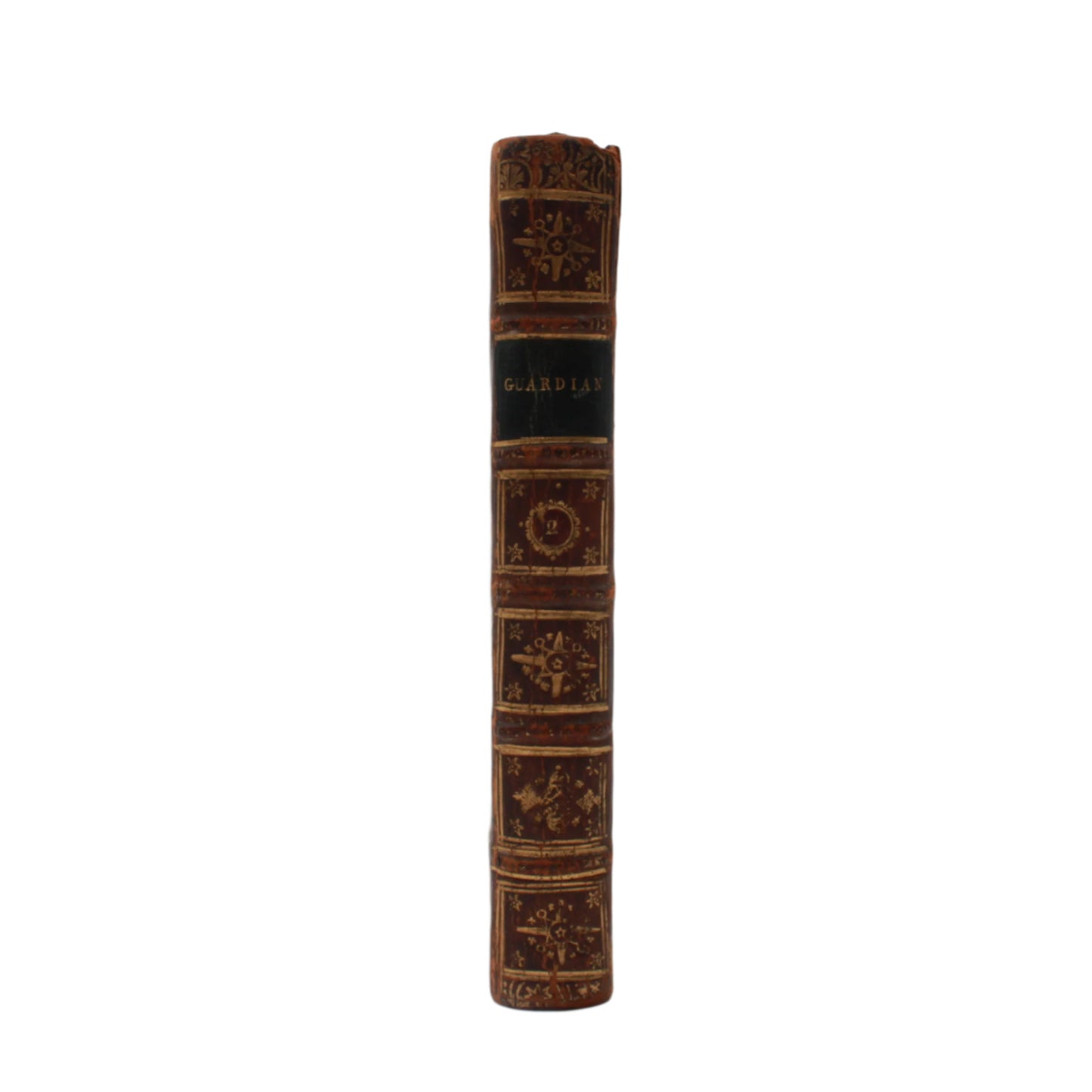
The Guardian, first published by Joseph Addison and Richard Steele in 1713, followed their earlier successes with The Tatler and The Spectator. This two-volume set, labeled as the “Fourth Edition” from 1726 and printed by J. Tonson in London, is an early 18th-century reprint of their collected essays. The Guardian offered moral, literary, and social reflections designed to encourage polite conversation and virtuous living, reflecting Addison and Steele’s goal to educate and refine readers through engaging writing. At a time when coffeehouses were centers of lively debate and the middle class sought thoughtful yet entertaining reading, these essays covered topics from literary critique to social behavior and politics, blending wit with moral guidance. Though shorter-lived than The Spectator, The Guardian played a key role in the English Enlightenment. This edition is also notable for its beautiful polished calf leather binding with gilt spine detailing, raised bands, and red-speckled edges—classic features of 18th-century craftsmanship. Personal touches like bookplates and inscriptions reveal the volumes’ history of ownership. In essence, this 1726 two-volume set not only preserves an important literary work but also showcases the elegance of Georgian bookbinding.
Condition:
Overall, these volumes appear to be in good antiquarian condition. The calf covers show wear consistent with age, including rubbing to the edges, corners, and spine ends. The gilt tooling and raised bands, though dulled in places, remain visible and contribute to the set’s classic aesthetic. Internally, the pages exhibit light browning and occasional foxing, typical of 18th-century paper, but the text remains legible throughout. The hinges are likely delicate yet still functional, given the books’ age, and inscriptions or bookplates inside add to the sense of historical ownership. In sum, it is a well-preserved and charming example of an influential Addison and Steele periodical, reflecting both the intellectual culture of the early 1700s and the fine binding traditions of the Georgian era.
Choosing a selection results in a full page refresh.
Opens in a new window.
Additional Information
Important Info About Antique & Vintage
Shipping & Returns
Additional Information
Complete set in 2 volumes
Written In English
The Guardian, first published by Joseph Addison and Richard Steele in 1713, followed their earlier successes with The Tatler and The Spectator. This two-volume set, labeled as the “Fourth Edition” from 1726 and printed by J. Tonson in London, is an early 18th-century reprint of their collected essays. The Guardian offered moral, literary, and social reflections designed to encourage polite conversation and virtuous living, reflecting Addison and Steele’s goal to educate and refine readers through engaging writing. At a time when coffeehouses were centers of lively debate and the middle class sought thoughtful yet entertaining reading, these essays covered topics from literary critique to social behavior and politics, blending wit with moral guidance. Though shorter-lived than The Spectator, The Guardian played a key role in the English Enlightenment. This edition is also notable for its beautiful polished calf leather binding with gilt spine detailing, raised bands, and red-speckled edges—classic features of 18th-century craftsmanship. Personal touches like bookplates and inscriptions reveal the volumes’ history of ownership. In essence, this 1726 two-volume set not only preserves an important literary work but also showcases the elegance of Georgian bookbinding.
Condition:
Overall, these volumes appear to be in good antiquarian condition. The calf covers show wear consistent with age, including rubbing to the edges, corners, and spine ends. The gilt tooling and raised bands, though dulled in places, remain visible and contribute to the set’s classic aesthetic. Internally, the pages exhibit light browning and occasional foxing, typical of 18th-century paper, but the text remains legible throughout. The hinges are likely delicate yet still functional, given the books’ age, and inscriptions or bookplates inside add to the sense of historical ownership. In sum, it is a well-preserved and charming example of an influential Addison and Steele periodical, reflecting both the intellectual culture of the early 1700s and the fine binding traditions of the Georgian era.
Important Info About Antique & Vintage
Vintage and antique items are unique and sold as is; small imperfections, patina, and prior repairs are part of their history.
Please review all photos, measurements, and the full description carefully before purchasing.
If you would like additional closeups, measurements, or provenance information we are happy to provide them; contact us before buying.
Any significant restoration, replacement parts, or condition issues are disclosed in the listing.
If authenticity or maker marks are important to you, please ask and we will share what we know.
For care or handling advice, contact us and we will recommend best practices to preserve your piece.
If you have concerns after delivery please reach out within seven days so we can assist.
Shipping & Returns
All Sales Are Final Each piece we offer is one of a kind and may show signs of its age and history. We do our best to photograph and describe any imperfections or wear so you can purchase with confidence. Please review all photos and details carefully and reach out if you would like more information before purchasing.
Shipping Timeframe Most orders ship within 3 to 5 business days. Larger or furniture pieces may take 6 to 9 business days. If there is ever a delay or special circumstance, we will contact you using the email you provide at checkout.
Missing, Stolen, or Damaged Packages While rare, shipping issues can happen. Please see our full Returns & Damaged Policy for the simple next steps if something goes wrong.